What Does a 0.5% Higher Mortgage Rate Actually Mean for Your Monthly Payment?
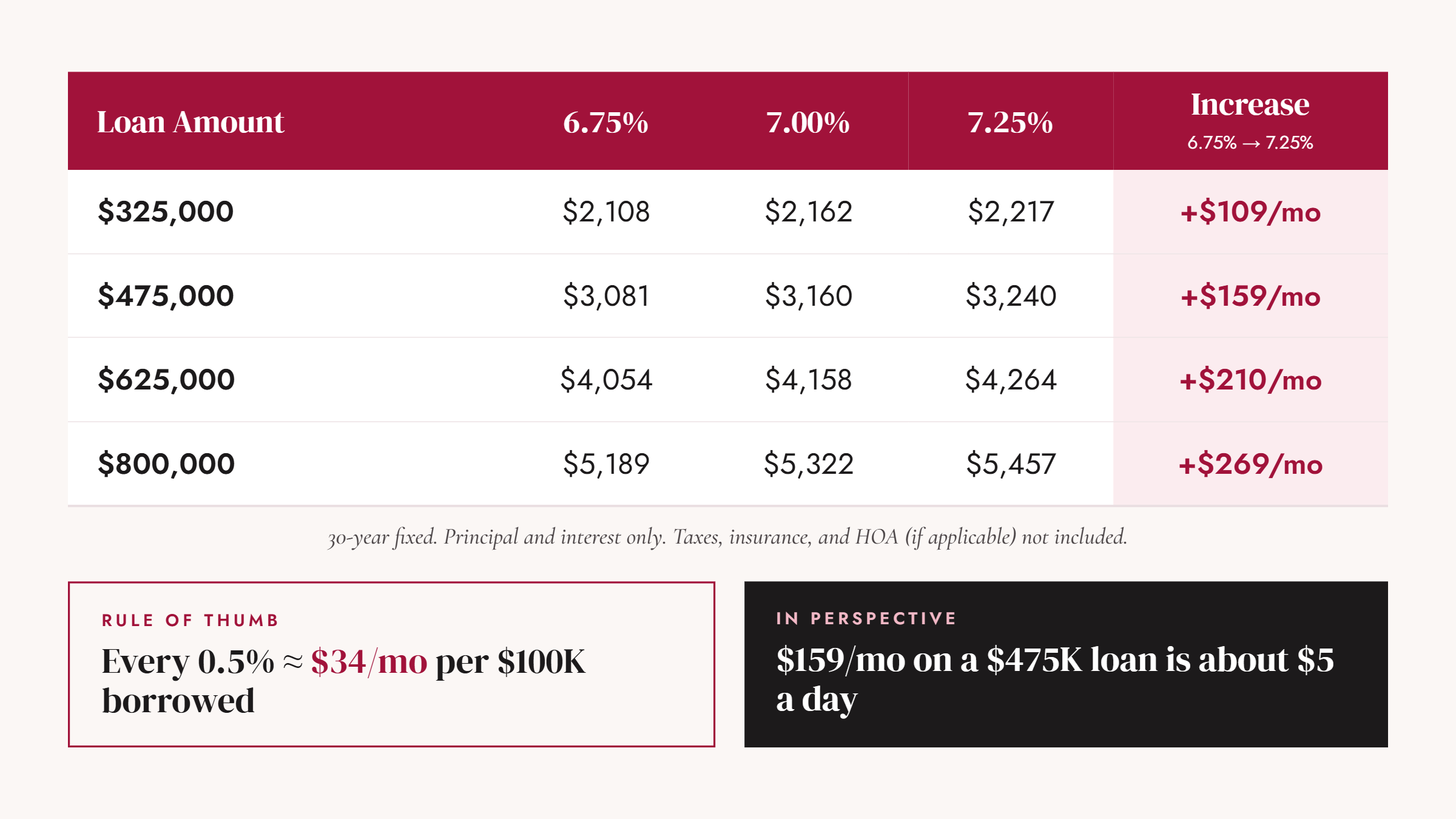
Table showing monthly principal and interest payments at 6.75%, 7.00% and 7.25% on a 30-year fixed loan, for loan amounts from $325,000 to $800,000. Moving from 6.75% to 7.25% adds $109 to $269 a month.
Mortgage rates are moving again. Freddie Mac's weekly survey put the 30-year fixed at 6.71% on September 3. By September 24, it was 7.03%.
Crossing 7% makes headlines. It makes buyers nervous. Some people stop shopping altogether.
But what does a half-point jump do to a real monthly payment? Here are the numbers.
Where Mortgage Rates Stand Right Now
According to Freddie Mac's September 24, 2026 release, the 30-year fixed-rate mortgage averaged 7.03%. The 15-year fixed averaged 6.42%.
A year ago, the 30-year was about 6.30%. So rates are higher than last fall. But Freddie Mac's chief economist, Sam Khater, noted that the housing market is still supported by "a solid labor market and an economy that is growing at a healthy rate."
You can follow the weekly numbers yourself on the Freddie Mac Primary Mortgage Market Survey.
The Real Cost of a 0.5% Rate Increase
Let's compare 6.75% and 7.25% on a 30-year fixed loan. These figures are principal and interest only. Taxes, insurance, and HOA dues are not included.
$325,000 Loan
- 6.75%: $2,108/month
- 7.00%: $2,162/month
- 7.25%: $2,217/month
- Difference: about $109 more per month
$475,000 Loan
- 6.75%: $3,081/month
- 7.00%: $3,160/month
- 7.25%: $3,240/month
- Difference: about $159 more per month
$625,000 Loan
- 6.75%: $4,054/month
- 7.00%: $4,158/month
- 7.25%: $4,264/month
- Difference: about $210 more per month
$800,000 Loan
- 6.75%: $5,189/month
- 7.00%: $5,322/month
- 7.25%: $5,457/month
- Difference: about $269 more per month
A Simple Rule of Thumb
At today's rate levels, every 0.5% change costs about $34 per month for each $100,000 you borrow.
Borrowing $400,000? A half-point move is roughly $135 a month. That is real money. But it is rarely the difference between affording a home and not affording one.
It's More About Perspective Than Percentage
"7%" sounds much bigger than "6.75%." The payment tells a calmer story.
On a $475,000 loan, the move from 6.75% to 7.25% adds about $159 a month. That is about $5 a day. For many households, that is one takeout lunch.
Now look at it over a longer period:
- Per year: about $1,900 more
- Over five years: about $9,600 more
- Over the full 30 years: about $57,000 more, if you never refinance or sell
That last number matters. But most homeowners do not keep the same loan for 30 years. They move, refinance, or pay down the balance early.
What Buyers Can Do When Rates Rise
A higher rate does not have to stop your plans. There are ways to manage it.
Consider a Rate Buydown
You can pay discount points to lower your rate. Sellers can also offer credits toward a temporary buydown, which lowers the payment in the first year or two.
Compare Loan Programs
Conventional, FHA, VA, and adjustable-rate mortgages each price differently. The best option depends on your credit, down payment, and how long you plan to stay.
Lock at the Right Time
A rate lock protects you from further increases while your loan closes. Timing your lock with your loan officer can save you from surprises.
Shop and Compare Offers
The Consumer Financial Protection Bureau recommends comparing Loan Estimates from more than one lender. Small differences in rate and fees add up.
Plan for a Future Refinance
If rates drop later, refinancing may lower your payment. Buying the right home now, at a payment you can manage, keeps that option open.
Waiting vs. Buying: The Other Side of the Math
Many buyers wait for rates to fall. That can work. But waiting has costs too.
- Home prices may keep rising while you wait.
- More buyers usually return when rates drop, which means more competition.
- Rent payments build no equity.
A $159 monthly difference can disappear quickly if the home price climbs by $25,000 in the meantime.
Same Goals. More Possibilities.
Rate headlines are loud. Your personal numbers matter more.
Before you decide to wait, find out what your actual payment would be. Learn more about your options at Mortgages by Sasha, or browse more home-buying tips on our mortgage blog.
Sasha Mrak Hendrickson, MBA
Team Lead & Mortgage Loan Originator | NMLS# 2574246
Buckingham Mortgage LLC | Company NMLS# 1124970
M: (202) 538-2118 | sasha@bfgusa.com
This article is for illustrative and educational purposes only and is not a loan commitment or approval. Payment examples assume a 30-year fixed loan and show principal and interest only. Actual rates, payments, and costs vary based on individual qualifications, loan program, property, and market conditions.
SEO Details
SEO Title: What Does a 0.5% Higher Mortgage Rate Mean for Your Payment?
SEO Description: Mortgage rates hit 7.03% in September 2026. See how much a 0.5% rate increase really adds to your monthly payment on loans from $325K to $800K.
Excerpt: Mortgage rates just crossed 7%. But what does a half-point increase actually do to your payment? We ran the numbers on four loan sizes. The difference may be smaller than you think.
